Wednesday, April 27, 2011

Paddling on the Canning

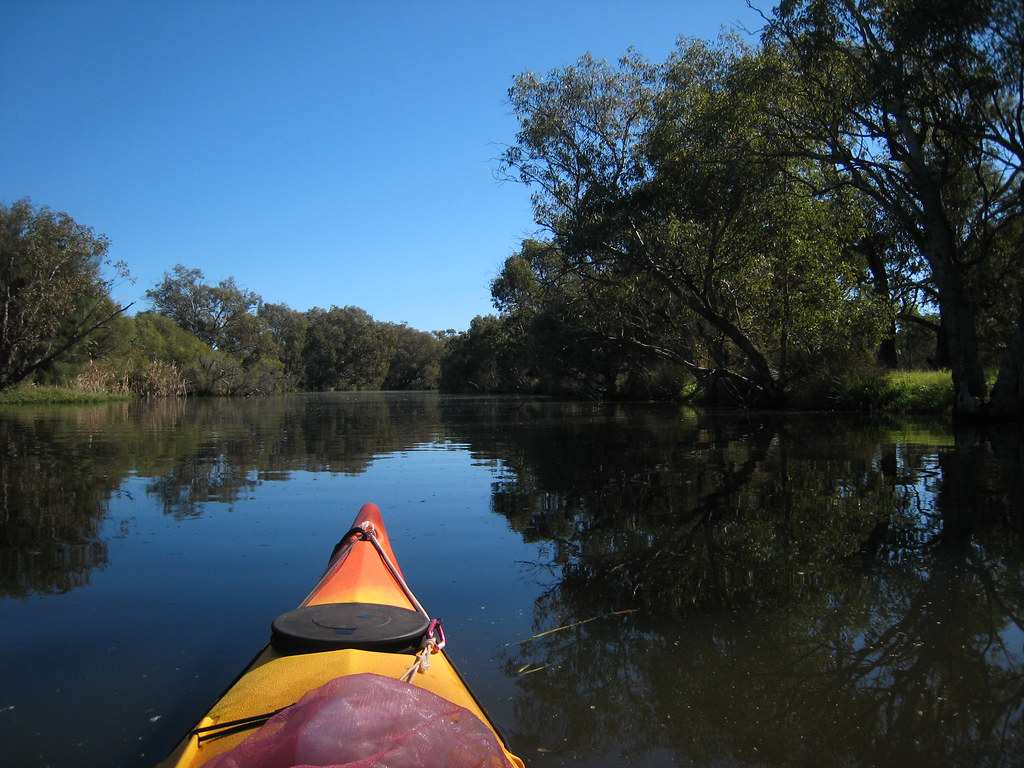
I endorse this strentch of the Swan River as a scenic and relaxing paddle. Go as fast or slow as you wish - there is no worry from the usual blights on the river: powered idiots in their pretentious stink boats trailing hoards of screaming brats in sea biscuits and terrorising squadrons of jet skiis. It is popular with recreational floaters, multisport trainers and that new creature that has recently appeared on our waters - the kayak fisherman (who more often seems to be using foot pedals or a small outboard).

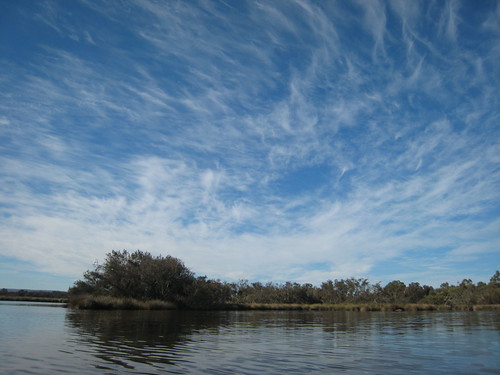
Yes - the route from Shelley Bridge to the Kent St Weir is the start of a nice paddle under the shade of sheoaks (Casuarina obesa), swamp paperbarks (Melaleuca rhaphiophylla) thickets, tall stands of flooded gums (Eucalyptus rudis) and  upwards further for about 7 kms to Nicholson Rd. It is all part of the Canning River Regional Park, and information on the paddle can be found here and here. 
It starts off at at a wide delta in the estuary dominated by sheoaks and paperbark thickets over thick stands of reeds and sedges (Isolepis and Juncus). Here you pass mobs of Australian pelicans, darters, pied and little black cormorants, Pacific black ducks, silver gulls and grey teal. Many birds do nest here, and I recently (4 weeks ago) spied the nest of a strange, squawking, so-ugly-they're-beautiful-and-disturbing-at-the-same-time darter chicks.

From there on, the river narrows to form several distant channels - so you can easily follow a channel to a dead end. No drama - all part of the fun. And the casuarinas here are full of mistletoe birds, mistloes, and I've spotted rufous whistlers, grey fantails, the ever-present angry willy wagtails, demented purple swamp hens, buff banded rails, white-faced herons, Australiasian coots, dusky moorhens, great egrets, osprey, collared sparrowhawks, whistling kites, brown honeyeaters, singing honeyeaters, wattlebirds, magpies, blue wrens, pee wees and kingfishers. Just to name a few.

And there is a really nice patch of Hakea prostrata in all its non-prostrate, fully erect, 3 m shrub form. This would have been more extensive vegetation structural association, but now you only get a few decent stands of tall shrubs of this species in the Perth area.

Mr Darter, in full breeding plumage - photo- Mr Dillon
And so you can paddle on until you pass the Castledare Minature Railway station - a boon for anorak-wearing, little-train buffs -  and swing around the corner to the weir at Kent street. This weir was installed to prevent salt water from reaching into the upper reaches of the Canning river and affecting farmland on the Canning plains. You will have to portage over this and head on up a few more kilometeres until the river becomes log-jammed, or you wish to turn around for the return leg.You may notice little freshwater fish species (like the pygmy perch) in the waters above the weir.
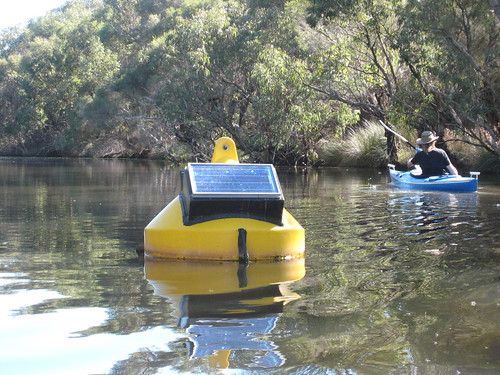
And you may pass these yellow things - they are oxygenators, which are an attempt to oxygenate the stagnant, eutrophic waters of the Canning River. Desperate measures - but certainly controlling the fertiliser inputs into the system would help - wouldn't they, eh? (i.e. tighter regulation of fertiliser use seems to be stalled).


Time of year to paddle: Anytime. It might rain one day in Perth, and this may even one day cause some water to spill over the weir. But don't get your hopes up.

Skill level: easy peasy grade 1 flatwater. Exposed, open stretches will become choppy and windswept if there are strong winds or stiff sea breezes. 

Attractions: Pleasant easy kayak in a little bushland setting. Lose yourself in the middle of the city - you can forgot for a while all the crappy MacMansion developments and just immerse yourself in the riparian environment and imagine what the wider area was like ages ago.

Location: 9 kilometres south-east of Central Perth,  in the Canning Regional Park. The park extends for approximately 6 kilometres along the Canning River between the Shelley and Nicholson Road Bridges.


Entry points: Loads. We start at Shelley Bridge, but you can start at Kent St Weir or other points along river.
Note: Pluses: sheltered waters, no powerboats, loads of birds and plants, loads of picnic spots.
           Minuses: low water flows means the water quality can be poor (hence the oxygenation pumps), with algal blooms and even Azolla and invasive Hydroctoyle infestations. A recent fire (Feb 2011) has damaged vegetation upstream of Kent St Weir.

The Kent Street Weir usually has to be portaged, and that pinic area can become very busy on weekends.

More information - More information on the park and its critters can be found here.

Monday, April 18, 2011

Art for the birds

and the dogs..

A public found-object art exhibition was held recently at Eric Singleton Bird Sanctuary, which is my usual birding spot. These events have been held before, but not at this specific location. I think the aim is to create with rubbish and refuse, thereby making recycled artworks that are also recyclable.

Anyhoo - it was a quick wander up the path, avoiding the supposedly leashed dogs and staring across the work reflected in the stormwater drainage ditch. As with previous years, the works were hit, miss or why.

These are coloured cones stuck in the mud adjacent to the drain. They're sort of reminscent of traffic cones, or large golf tees. I'll duck for cover if I hear a booming cry of those fateful words    "Fore!!"
And this is some fungal-like sculpture crafted from the dog shitbags which are so oft found in parks, distributed with the intention for their use to contain the dos, but not necessarily do the bag and contents find their way in a bin. I like this sculpture, oddly enough, because it is a woven netted form which reminds me of the gills/vellum of a morel stinkhorn. Coincidentally, the smell from a discarded, used dog bag also reminds me of a stinkhorn - but I'm certain that wasn't the desired intention of the artist.

 And these are little paper house things. Or something. I should have read the label. But, judging from the deeply set footprints, the people installing the exhibit may have had a fun time extracting themselves from the mud. At least they didn't require a helicopter to secure their rescue

.

A pelican - reel to reel. Clever one this one.


Fish - all strung out.

Plastic sheet strung between two trees... another why category. I think the title was something like "screen", so it wasn't a commentary on arboreal plastic sheeting ..
 
Diving cormorants - with final scene of bird with ringpull plastic

and finally - Birdcage - with reversed roles. Oh why don't we see more of this scene.


Soooooooo.... that's a sunny afternoon ramble down the park, away from the dogs, among the birds of the santuary. Needless to say, the ponds themselves have enough water to be enjoyed the birds.


Tree - frame - tree


Thursday, January 20, 2011

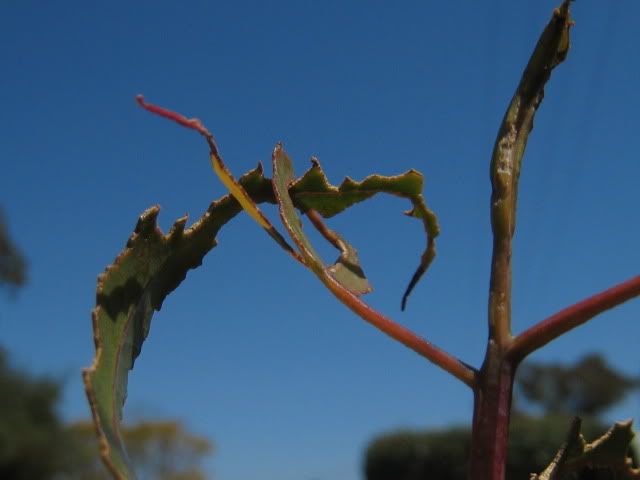
Who's eating me trees?

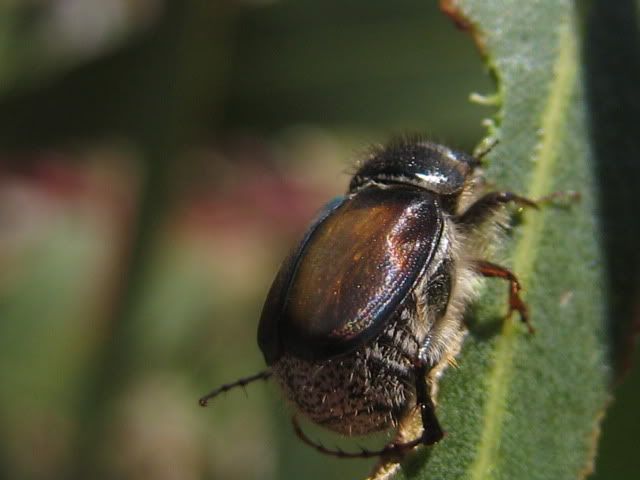
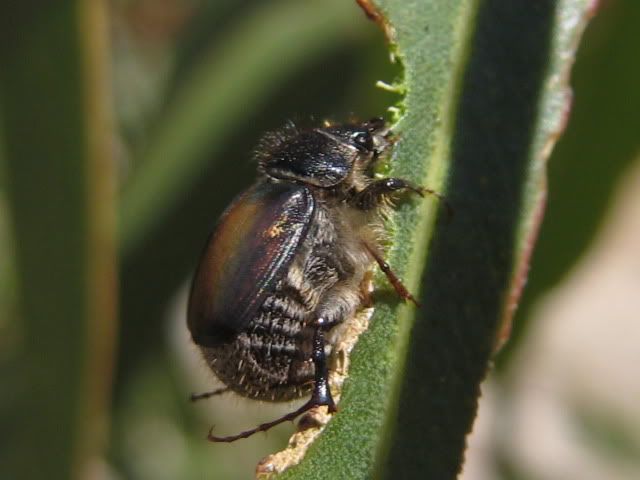
A chafer at my tree

Liparetrus sp -(Scarabaeidae: Melolonthinae). Spring beetles.

This scarab chafer beetle (cockchafer if you must) is pictured eating my treasured front verge saplings of illyarrie (Eucalyptus erythrocorys) and Eucalyptus todtiana. They emerged en masse from burrows in the sandy soil of the Swan Coastal Plain in late spring (October), literally swarming out of the ground after the grubs have lain for a year or two


Once up and out as adults, they showed a remarkable ability to defoliate my native eucalypt saplings. It is frighteningly impressive how much leaf biomass can disappear within days as 'undreds of the chafers swarm over that plants. And they do swarm. And persist in eating the trees despite constant shakes and hosing down the plants. These are my saplings that I planted on the front verge, and they have only really started to take off, so you can imagine my horror as they disappeared over days. I received some advice on how to manage them, which involved lights, hosings, shakings and tolerance.


Anyways - to cut the long story short - I requested the help of an entomologist friend who became rather excited at these critters. Yes, they were a chafer beetle (as I had gussed), in the genus Liparetrus and could not be identitifed to species level. They were native and possibly even an endemic to the Swan Coastal Plain or SW Western Australian region. Yes, spring beetles are considered pests and usually sprayed when they occur in gum plantations - but these were local critters in small numbers in suburban gardens.  I was lucky that some beetle work was being currently underway at the WA Museum, so my critters attracted some interest.

Looks like we will have to resort to DNA sequencing and some good, old fashioned taxonomic work to get a species name on this critter. Yes - that involves counting setae.  I'm really impressed that common old suburbia continues to turn up undescribed species. I just have to plant some more local eucalypts to reduce the damage on my street trees and to support these (possibly endemic?) species in an region subject to huge amounts of bushland clearing.


Wednesday, November 10, 2010

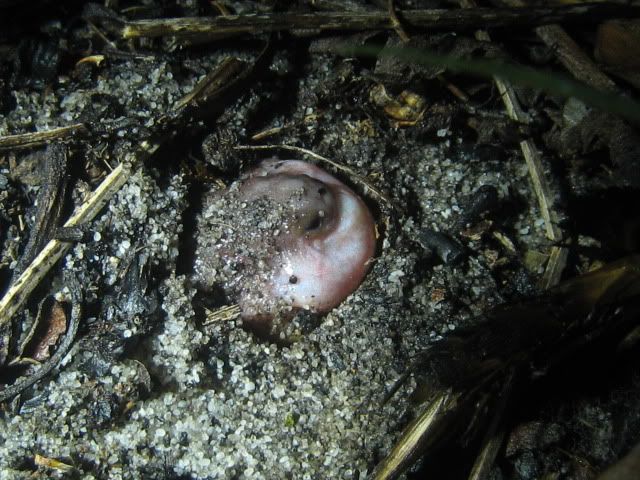
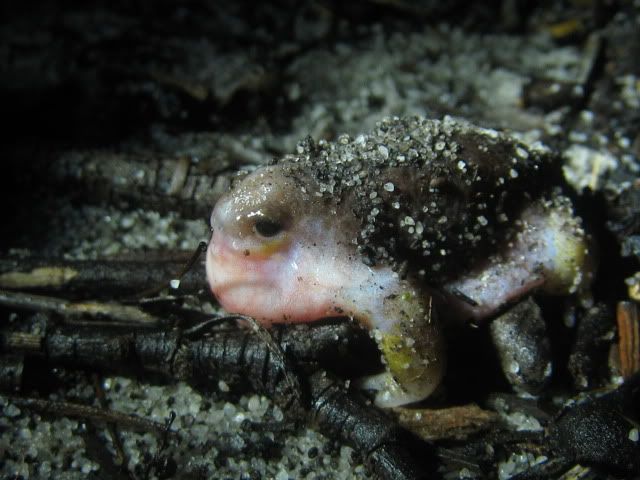
Turtle frogs - just bizarre

So ugly they're beautiful  sorta cute...

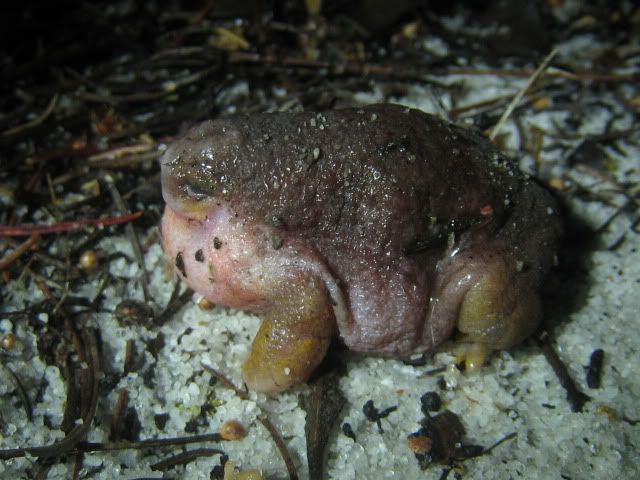
Myobatrachus gouldii

It has been a dry dry winter and spring, except some decent rainfall last night brought out the call that turtle frogs would be about.

I've never seen one before, and thought that they were impossible difficult to see, and only the most dedicated herp freaks would ever have a prime viewing experience.

But no - they're far more common than I had thought, and last night was the night to see them crawling around on the surface, calling out to the ladies, looking for a mate to spend their summer with deep down in a burrow of love.

The live in SW Western Australia, on sandy soils - hence they do well on the Swan Coastal Plain - a place of exceptional sandyness. It would appears that a number of significant bushland reserves, like Whiteman Park, Bold Park and Kings Park, have sizeable populations of turtle frogs lurking in these sandy soils. They spend most of the lives nudging their way face first in the sand, burrowing away in a fossorial manner, eating termites. Termites!

But there are a very few occasions when the critters come to the sandy surface, and  this is usually spring-summer on the first night of/after the first heavy rainfall.

So - spring rains mean pairing for the frogs, followed by a summer spent together in a burrow, summer mating and egg laying, and then these eggs develop directly into froglets. That's pretty amazing.

The call is a deep, throaty "murrrp" and there were .. well.. from the sounds of it.. 'undreds of 'em.  And they're tiny - only about 2 -3 cm long (SVL). They can be hard to spot, but when you finally triangulate their location and peer around - there they are! On the soil surface, looking a bit like a cross between a marri nut and a strawberry bubblegum bubble.Or in a burrow entrace or depression in the sand.

No bulgy froggy eyes for these guys - they have tiny, deeply inset eyes like a microbat or mole, apparently covered a protective membrane. They have a saggy, oversized skin which appears to inflate like a bubblegum bubble. They're also pinkish - which takes their resemblance to a bubblegum bubble even more.. And chunky arms. They have chunky arms for digging face first through sand.

That's great - thanks to those who alerted me to finding this amazing frog, and I'll keep an ear out for them again next time we get the decent rains...

http://frogs.org.au/frogs/species/Myobatrachus/gouldi/

http://frogwatch.museum.wa.gov.au/Southwest/SwanCoastalPlain/435.aspx


Tuesday, August 31, 2010

Wattle Day - Woodmans Acacia

September 1st is Wattle Day - 

huzzah - 


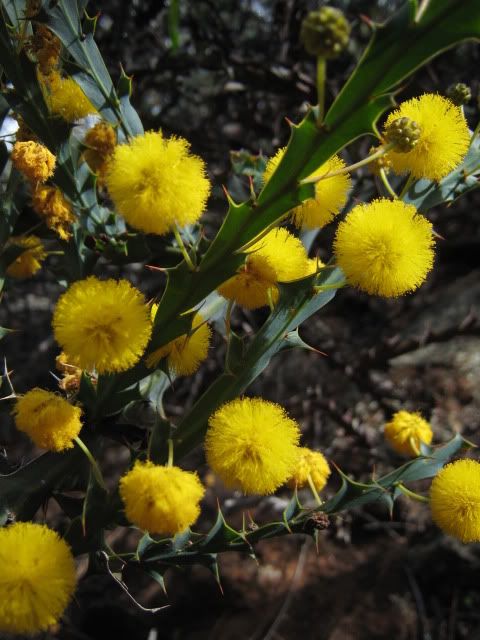
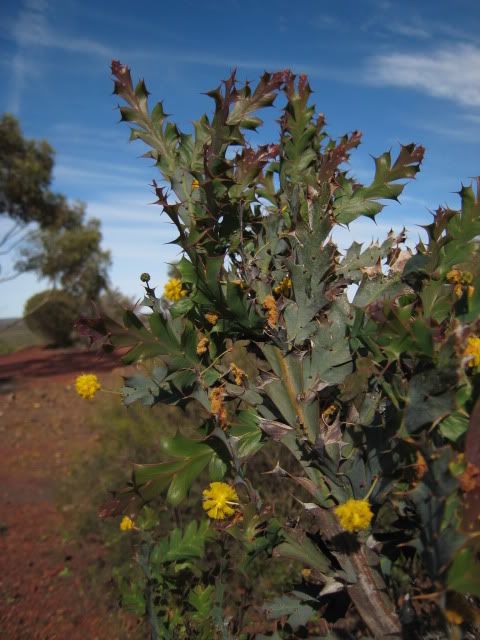
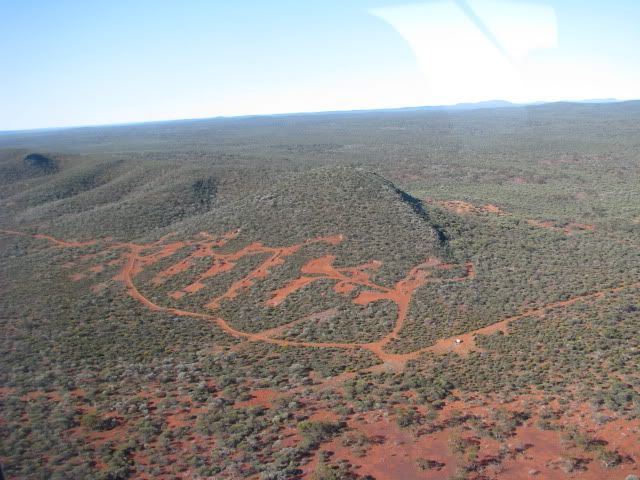
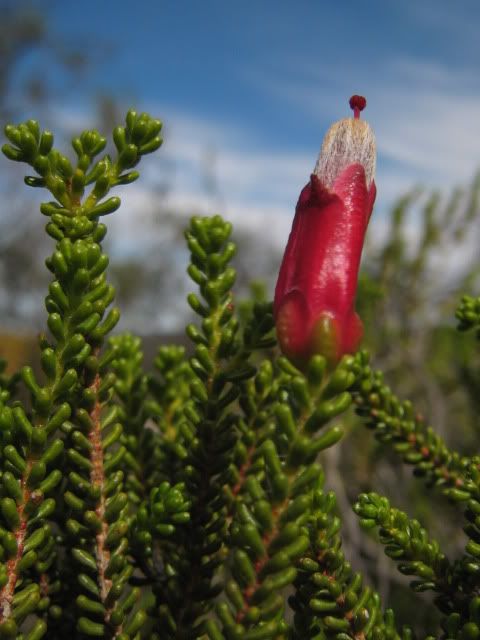
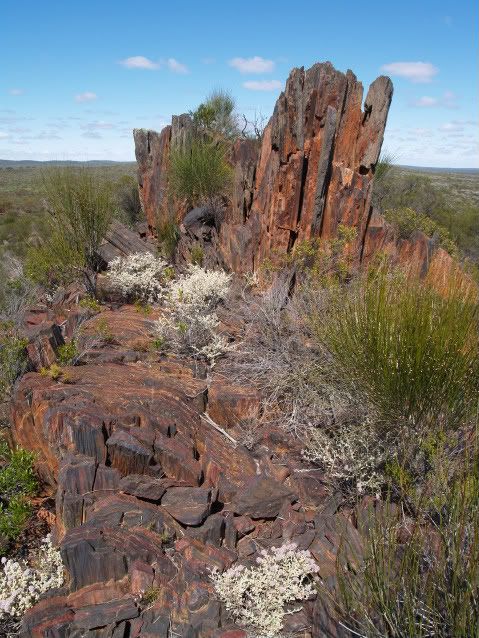
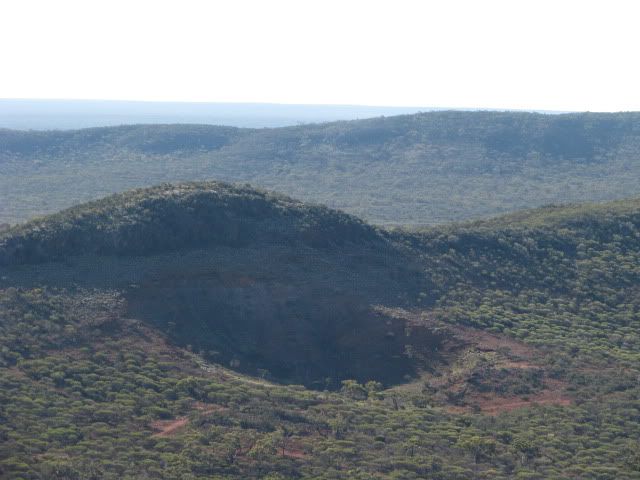
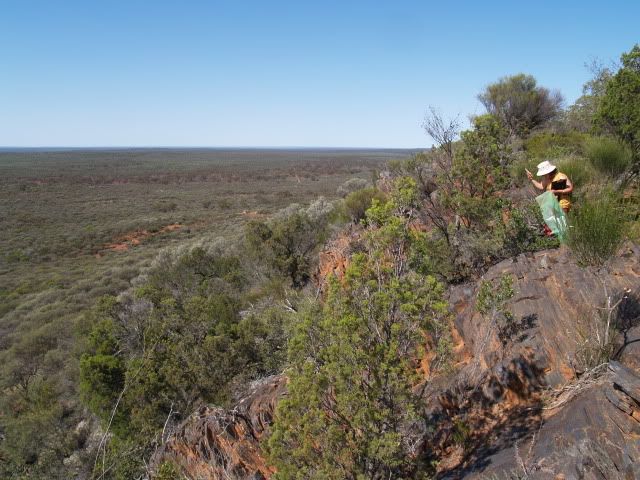
So I'm using this day to profile a little wattle battler - Woodman's Acacia or Acacia woodmaniorum. This shrub straggles its way over the banded iron formation (BIF) ranges near the Blue Hills, in the midwest of Western Australia. This is this only place where it grows, miles away from  its presumed closest relative (Acacia alata var. biglandulosa). The description is here.

It has angular stems and flattened phyllodes which are decurrent along the stems of branchlets  - making this another winged wattle. The flowers are bunched in solitary little pom-pom inflorescences which pop out of the stems on moderately long peduncles. Despite the 'leafy, green' appearance, this plant packs of punch of spines on the phyllode tips.


Named after the three Woodman brothers of local botanical fame in Western Australia , this wattle was named and declared rare as soon as surveys in the midwest established that it was new and very restricted in distribution. The greates threats this little hardy acacia faces is open cast iron ore mining, since its preferred habitat is atop the haemtite-rich hills of BIF. It will pop up in crush rock spoils, to a degree.


This species shares it habitat with other interesting and plants like the Drummondita fulva (endemic to the Blue Hills - Yalgoo region), Rhodanthe collina and generally splendid and species rich Acacia - Melaleuca nematophylla shrublands, rich heaths and stands of Callitris columellaris on rocky hillslopes and ridge tops.

Given how incrediblely flat the general midwest region is - these are truely outstanding landforms with differnet plants and communities on the tops from the vast surrounds of seemingly endless mulga - bowgada shrublands.

Saturday, July 24, 2010

Gwelup fungal goodness

Now that it has rained after weeks of cold, dry winter, all the wee mushrooms are poking up their fruiting bodies. So it was opportune weather for a fungal foray at Gwelup bushland on the weekend. This reserve is tucked away in Perth north-west suburbs, and is a piece of remnant tuart woodland which is a but fragment of what was an extensive sweeping continuous community ranging from Yanchep to Busselton.

This Tuart woodland has a canopy in good condition, dominated by tuart (Eucalyptus gomphocephala) and sheoaks (Allocasuarina fraseriana). However, the understory is rather weedy, what with a history of being a stock route during settlement. So there is a fair bit of Gladiolus caryophyllaceus, Hypochaeris radicata, Pelargonium capitatum, Asparagus asparagoides and Avena barabata and Erharta longifolia.

But we were there for the fungi - and the wet, cold conditions provided.

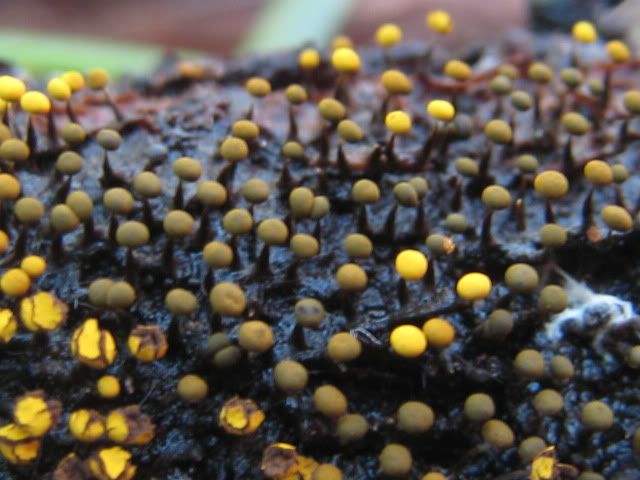
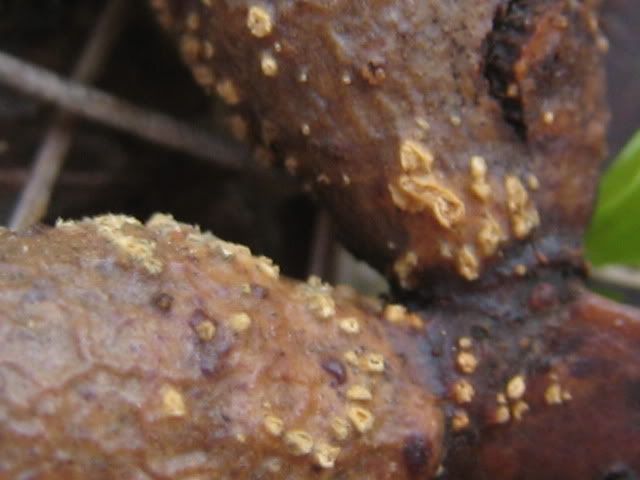
Here is a quick photo inventory of what we found within two hours. There slime moulds on rotten wood. Including the strangely named Icicle fairy fans (Ceratiomyxa fruticulosa) and the unnamable slime mould with vivid yellow sporangia.


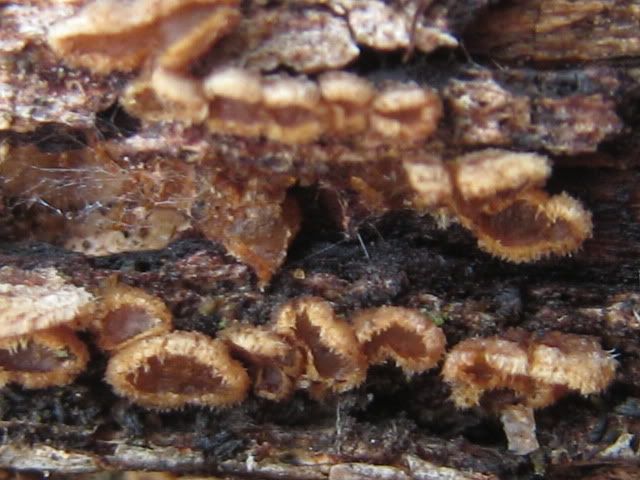
With fruiting bodies only milimetres in length, there was a little Stereum sp ? hirsutum growing on rotting wood.


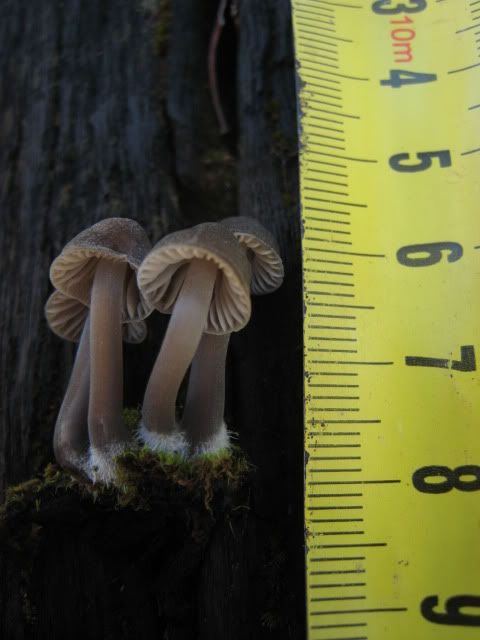
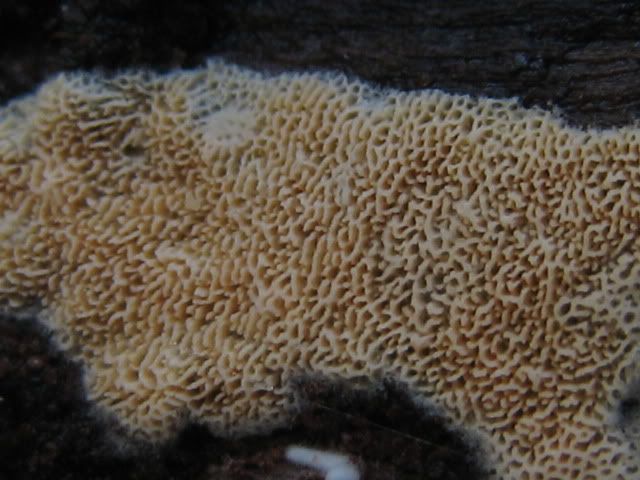
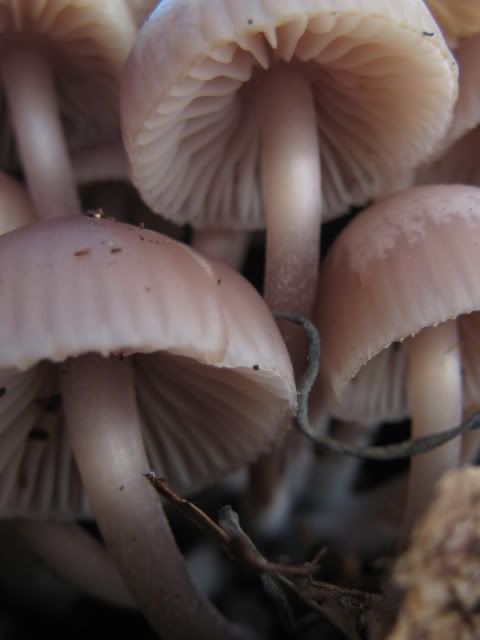
Other tiny treasures included Mycenea sp. (left, next to the ruler), which was growing on rotten tuart log. Another rotten tuart branch yielded this beige-coloured skin fungus (Asterstroma persimile - I think).


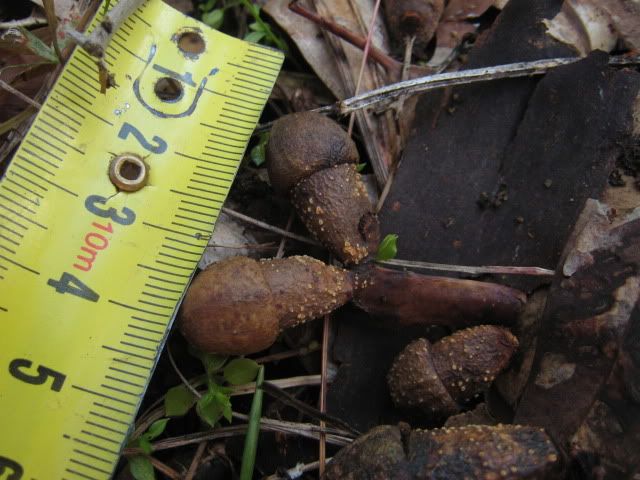
Growing on tuart nuts was the aptly named tuart nut fungus (Harknessia uromycoides).


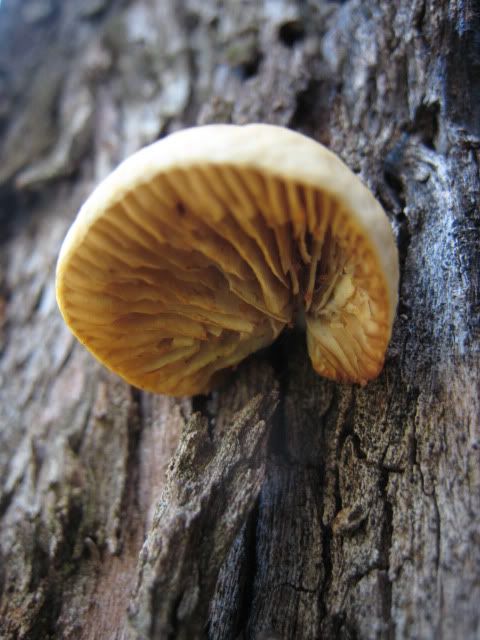
 And this Crepidotus eucalyptorum on tuart bark.


Clark's mycena (Mycena clarkeana) on melaleuca wood...

 .......and the vividly warm golden tuart cortinarius (Cortinarus ochraceofulvus) which ia mychorrizal on tuart roots.

And last little critter which caught out attention but wasn't at all fungal, was this cute native Bothriembryon sp., and it wouldn't surprise me if it was an endemic species of tuart woodlands on the Swan Coastal Plain.

Sunday, June 13, 2010

The Mighty Sevylor on the Millstream

Kayaking is great way to see the river scenery and wildlife. And my trusty plastic touring and seakayaks have been put to good use to travel the estuaries and inlets of SWWA.

But there are times when lugging 25 - 40 odd kilos of plastic on a car and through the bush is just not practical -

                              and so to promote the inflatable yaks.

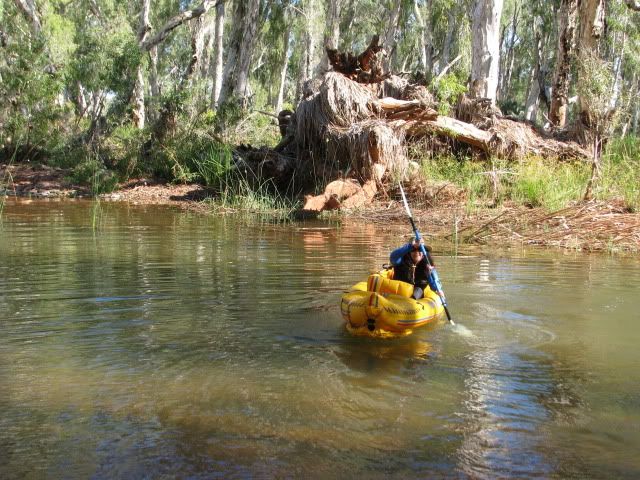
The Mighty Sevylor is a 5 kg lump of plastic sheeting, inflated with a low pressure hand pump. Fitting snuggly in the back of the low-clearance-and-inappropriate-vehicle-for-road-touring subaru imprezza, the Mighty Sevylor proved its $ 100 - 200 worth at Millstream-Chichester National Park.


Minutes to inflate, hours to paddle - our two person boat was a snug fit for two. It is good that we're both short-arses, but the boat is fine for a single paddler to handle. Okay - so it doesn't rate highly for speed, but The Mighty Sevylor is convenient, stable, lightweight and perfect to take along on road trips when space and weight are at a premium. Perfect for spontaneous paddles.

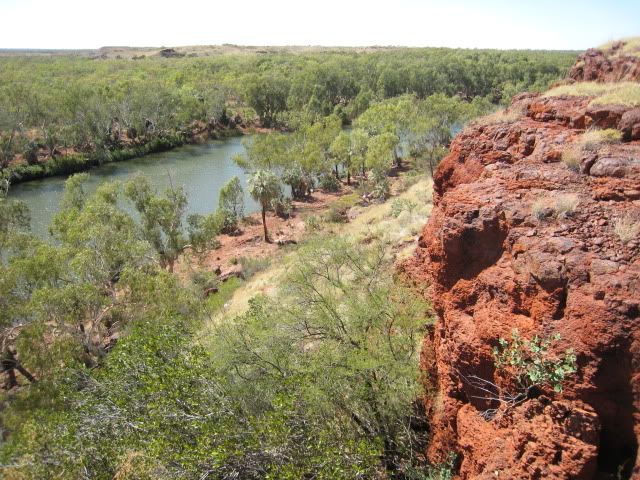
Just upstream (west) from the Crossing Pool campsite, there is an easy access point at the ford and pipeline crossing over the Fortescue River. This allows for an easy 3 km of paddling upstream before you reach some rapids and melaleuca thicket, which can be easily portaged if you wish to go further. You can also try downstream from the ford, so long as you are prepared for portages.

Dense stands of Melaleuca argentea line the river, as well as the endemic millstream palm (Livistona alfredii). Expect to see a lot of birds, including rainbow be eaters, little black cormorants, black swans and blue winged kookaburras, zebra and star finches, butcher birds etc..

The river bank is easily accessible and open to walk along because the undergrowth is relatively sparse. Feral cattle are obviously keeping this more open, and intermittant flood events will scour the braided stream beds.

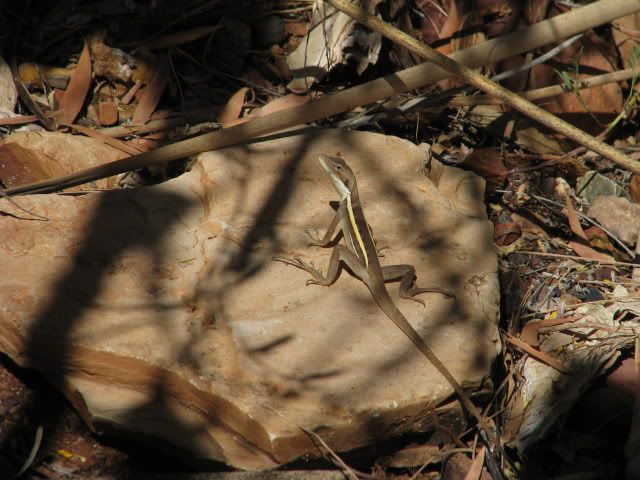
Keep you eyes open for ta ta lizards / long-nosed water dragons (Lophognathus longirostris) on the rocks and tree trunks..

Obviously  paddle only at low - moderate water levels and not during flood events. Winter is a perfect time for a paddle on the Fortescue because the weather is relatively mild  to warm for the Pilbara, plants are still flowering, the road are most accessible and mostly likley to be open have been graded by that time of year.


Time of year to paddle: Winter - spring (May - October). Avoid during flood events or predicted flood events. This means being aware of heavy rainfall in other parts of the Fortescue catchment.

Skill level: Easy. Grade 1- 2 (flatwater). Some moving water and minor rapids and ti-tree thickets.

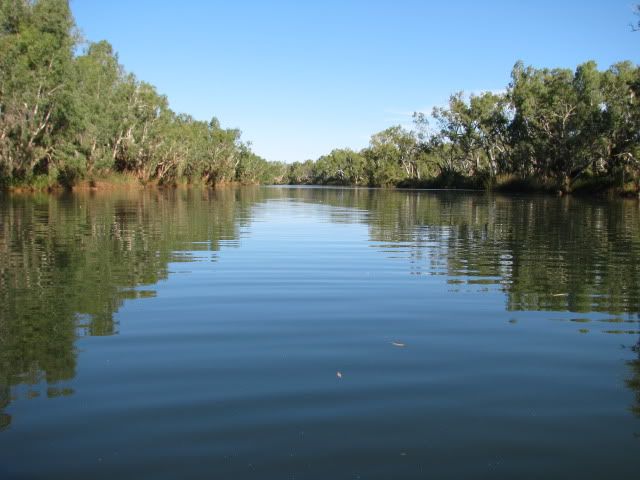
Attractions: Pleasant easy kayak along wide, majestic river lined with tall, lush riparian vegetation and passing by specular mesas and rock outcrops.

Entry points: 2WD - Crossing Pool campsite and ford over Fortescue. Expect portages to get to long pools. Other points are also accessible with 4WD.

Note: Some areas of the river are of high cultural signifiance to the Yindjibarndi people and recreational water activities are not permitted.

More information - http://www.warluway.com.au/icons/millstream-chichester-national-park.aspx